




Key Takeaways
- Understand the five stages of the Technology Adoption Curve—from Innovators to Laggards—to predict how new tech will spread through your industry.
- Learn how early adoption drives market differentiation, operational efficiency, and higher employee morale by using the industry’s best tools.
- Review real-world cautionary tales of market leaders who failed to pivot, illustrating why technological hesitation can lead to permanent loss of market share.
- Discover how operating on the "left side" of the curve fuels innovation, while the "right side" optimizes capital allocation and market dominance.
- Prepare for a structured "Tech Adoption Audit" to determine where your company currently sits and where it needs to be to thrive.
In today’s fast-moving digital landscape, companies are faced with a crucial question: When should we adopt the newest technology? Too early, and the risks of unproven solutions could be costly. Too late, and competitors may have already built an insurmountable advantage. The key to answering this question lies in understanding the Technology Adoption Framework, a methodology that helps to explain how innovation spreads within a given industry segment and the different strategies corporations can use to help navigate disruptive technology shifts.
Here, we’ll break down the Technology Adoption Framework, examine real-world examples of its impact, and set the stage for how businesses can strategically approach digital transformation.
It starts with Understanding The Technology Adoption Curve
The Technology Adoption Curve is based on Everett Rogers 'Diffusion of Innovations model, which explains how new ideas, technologies, and behaviors spread through a population. The model divides adopters into five categories:
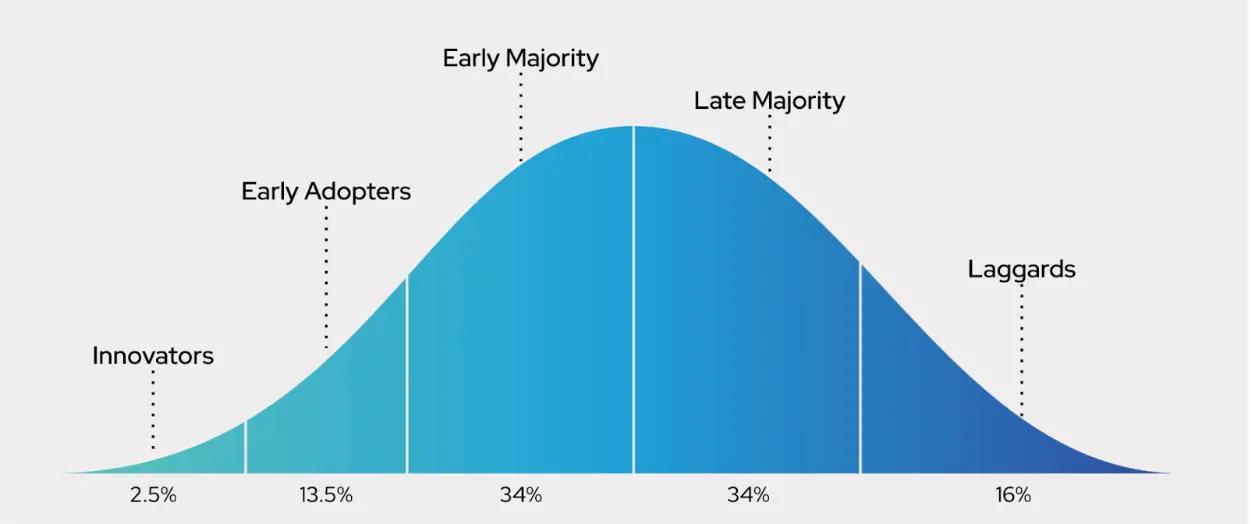
- Innovators (2.5%)– The trailblazers who experiment with cutting-edge technology, often before it’s fully tested or commercially viable.
- Early Adopters (13.5%)– Visionary leaders who see potential and move quickly to integrate new technology, often gaining the first-mover advantage.
- Early Majority (34%)– Pragmatic adopters who embrace new technology once it’s proven and widely accepted.
- Late Majority (34%)– Conservative adopters who wait until a technology is fully mainstream and risk-free.
- Laggards (16%)– Those who resist change and adopt new technology only when absolutely necessary.
For businesses, understanding where they fall on this curve isn’t just an academic exercise—it’s a crucial factor in determining long-term success. Companies that consistently operate on the left side of the curve (Innovators and Early Adopters) often reap first-mover advantages over their competitors. Those more comfortable on the right side of the curve (Early & Late Majority) are better at predictive capital allocation and extending existing market dominance.
How Early Adoption Can Create Competitive Advantage
Early adoption of disruptive technology isn’t just about staying trendy—it’s about securing a sustainable competitive advantage. Here’s why:
- Market Differentiation– Being among the first to leverage new technology allows companies to create unique customer experiences that competitors can’t immediately replicate.
- Operational Efficiency– Early adopters often gain productivity and cost advantages before the rest of the industry catches up.
- Customer Loyalty & Brand Perception– Companies seen as innovators attract tech-savvy customers who value cutting-edge solutions.
- Data & Learning– The earlier an organization adopts a new technology, the more time it has to refine and optimize its implementation.
- Culture & Morale - The best employees want to work with the best tools, and will find professional opportunities that allow them to do so!
Examples of Early Adoption in Action
- Amazon and Cloud Computing– In the early 2000s, Amazon adopted and pioneered cloud computing before most enterprises even understood its potential. The result? AWS (Amazon Web Services) became the backbone of the internet, generating billions in revenue.
- Apple and the Smartphone Revolution– Apple wasn’t the first to create a smartphone, but by aggressively innovating with the iPhone in 2007, they defined the modern smartphone era. While competitors scrambled to catch up, Apple set the standard for mobile technology, app ecosystems, and user experience.
- Nvidia and AI/GPUs– Nvidia initially focused on graphics cards for gaming, but they recognized the potential for GPUs in artificial intelligence and machine learning early on. By doubling down on AI acceleration, Nvidia became a dominant force in the AI revolution, with its chips now powering everything from autonomous vehicles to ChatGPT.
- Starbucks and Mobile Payments– While many retailers hesitated, Starbucks leaned into mobile payments and loyalty-driven digital experiences, creating one of the most successful mobile payment ecosystems in the world. Their early adoption of mobile ordering and AI-driven personalization keeps them ahead of competitors.
- MinuteClinic (Acquired by CVS Health in 2006)– Originally founded in 2000 in Minnesota, MinuteClinic was among the first to introduce walk-in, retail-based healthcare services staffed by nurse practitioners. They leveraged commercially available technology (online scheduling, maturing EHR platforms, integration with insurance/payor platforms) to focus on convenience, offering treatment for minor illnesses, vaccinations, and screenings inside retail stores. Once CVS acquired them, they rapidly expanded nationwide, integrating with the pharmacy chain's broader healthcare strategy.
These companies didn’t just follow trends—they actively created them. And by doing so, they built competitive advantages that their industries have spent years trying to close.
The Risk of Lagging Behind
While early adoption has clear benefits, late adoption can be devastating. Consider these examples:
- Retail Giants and E-commerce– While companies like Amazon embraced e-commerce early, major retailers hesitated. By the time they shifted online, they had lost market share that they’ll likely never recover.
- Blackberry and the App Revolution -BlackBerry (formerly RIM) was once the gold standard in business mobile communication, famous for its physical keyboard and secure email capabilities. However, it dismissed the importance of touchscreens and third-party app ecosystems, believing its core business users would remain loyal. As Apple and Android phones surged in popularity with app-driven experiences, BlackBerry’s resistance to change led to its rapid decline.
- IBM and the Personal Computer Market- IBM was an early leader in personal computers, but failed to anticipate the shift toward consumer-friendly, mass-market PCs in the 1980s and 1990s. While companies like Microsoft and Dell focused on software ecosystems and affordability, IBM stuck to high-cost enterprise solutions. They eventually sold off their PC business to Lenovo, exiting a market they once helped create.
The lesson? Technology doesn’t wait. Companies that hesitate risk not just falling behind—but becoming obsolete.
How Should Businesses Approach Technology Adoption?
So, how can companies ensure their technology adoption strategy supports their corporate goals and overarching strategic vision? While every organization’s journey will be different, a proactive approach to implementing the technology adoption framework is essential.
In the upcoming articles, we’ll explore:
- How to Build Your Technology Adoption Curve -How to map out how a given technology innovation impacts your industry.
- What is Your Corporate Technology Persona?– Understanding where your company sits on the adoption curve and how it affects growth.
- Strategies for Optimizing Technology Adoption– Tactics for efficiently identifying, testing, and scaling new technologies within your organization.
- Building your Technology Adoption Pipeline– Practical steps for businesses looking to move towards the left side of the curve.
- Getting Started: How to Perform a "Tech Adoption Audit” within your company– A structured approach to evaluating your company’s readiness for digital transformation.
The future belongs to companies that take a deliberate approach to navigating technology-driven change. Where does your company sit on the Technology Adoption Curve? And more importantly—where must it be to thrive?"