



For the modern restaurant operator, the dream of a "seamless digital experience" often feels more like a nightmare of disconnected websites and dashboards. As fast-casual chains expand they inevitably adopt tools and systems required to support the increasing complexity of their model. We call the net result a "Frankenstein" tech stack.
It starts innocently enough: you choose a best-in-class POS like Toast or Clover. Then you add a loyalty program like Punchh or Thanxx. To handle the surge in off-premise orders, you bring in Olo as a digital ordering platform, and to manage the parking lot chaos, you integrate Klaviyo to manage your marketing automations. Individually, these tools are powerful. Collectively, they are often a disorganized mess of data silos that ultimately impact your carefully curated guest experience.
The solution isn't adding more tools. The solution is orchestration.
The Orchestration Layer: The "Brain" Your FoodTech Stack is Missing
In a traditional setup, your various tech vendors are like musicians playing in separate rooms. They are all talented, but there is no conductor. The guest is left trying to hear the melody through the walls.
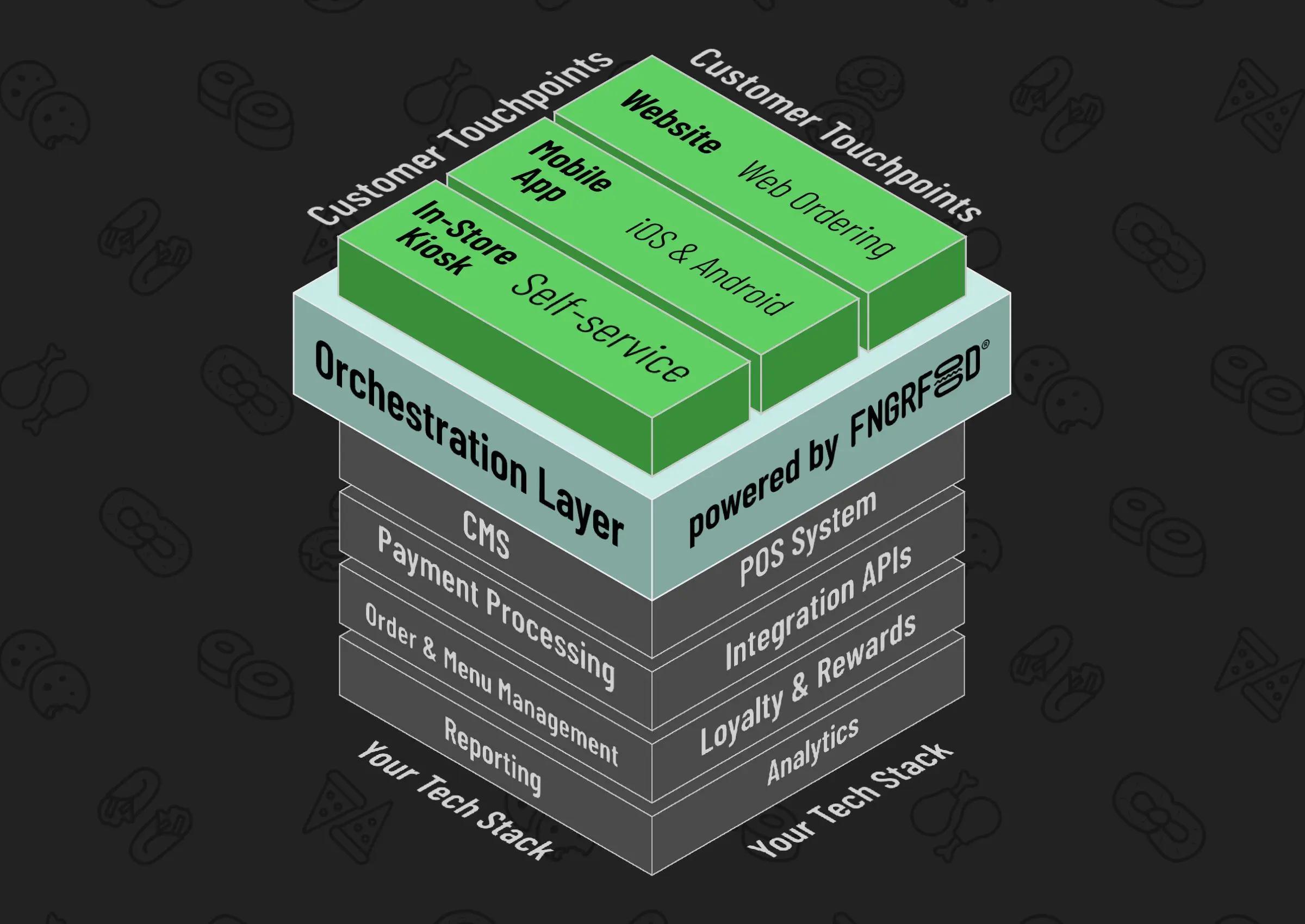
FNGRFOOD was designed to be the conductor. It provides a cloud-native orchestration layer that sits between your back-of-house operations and your front-end guest interface. Instead of building multiple front-ends each managing a set of complex integrations, FNGRFOOD acts as a middleman for all.
FNGRFOOD ingests the data from your back-end systems (Like your ordering platform, marketing technology, loyalty solution and payment systems) and presents a single end-point to your front-end applications. The result is a single, high-performance data stream, that keeps all your guests on the same page regardless of which platform they use. This isn't just a technical convenience; it’s a fundamental shift in how a restaurant functions.
The Hattie B’s Case Study: Orchestration in Action
When we launched the new digital experience for Hattie B’s Hot Chicken, the complexity behind the scenes was significant. Hattie B’s needed to manage high-volume ordering across multiple states, each with different tax laws, menu availability, and different "Coop Club" loyalty tiers.
By using FNGRFOOD as the orchestration layer, we turned that complexity into a competitive advantage:
- Unified Loyalty: Because FNGRFOOD speaks easily to Punchh their entire history is instantly available to the front-end. If they have a reward for a free side of "Pimento Mac & Cheese," the app knows it, the POS honors it, and the data is tracked without a cross-system manual entry.
- The Perfect Handoff: Friction in the parking lot is a brand-killer. By orchestrating Flybuy’s location intelligence, the Hattie B’s kitchen staff receives an alert exactly when the guest is two minutes away.
- Real-Time Menu Integrity: There is nothing more frustrating for a guest than ordering a "Peach Cobbler" only to be told ten minutes later it’s out of stock. FNGRFOOD’s orchestration ensures that when an item is “86’d,” it vanishes from the web and mobile app at the same time.
Why "Easy to Work With" is a Technical Specification
In the world of Enterprise SaaS, "integration" is often a dirty word that implies months of expensive development work. We built FNGRFOOD to be the opposite. We wanted to be the partner that other tech companies want to work with.
This philosophy is reflected in the feedback from our partners. As the team at Punchh noted, "They are a rare partner that balances high-level engineering with a deep understanding of restaurant operations." By making the orchestration layer easy to deploy, we allow restaurant owners to stop acting as amateur IT directors and get back to being restaurateurs. You shouldn't have to care about API documentation to ensure your guest gets their loyalty points; you just need a system that works.
The Operational ROI of Connectivity
The return on investment for orchestration shows up in three key areas:
- Labor Efficiency: When systems talk to each other, your team spends less time filling the gaps and more time focusing on the food.
- Reduced Tech Debt: Instead of building custom code to connect "Tool A" to "Tool B," you use a platform designed to connect everything. This makes it easier to swap out tools in the future without rebuilding your entire app.
- Digital Experience Parity: Our multi-platform approach means that your customers get the same functionality they expect regardless of where they transact. Web, Mobile & Kiosk transactions all provide a full and robust customer experience.
Conclusion: Stop Integrating, Start Orchestrating
The "Frankenstein" stack is a symptom of a growing brand, but it doesn't have to be a permanent condition. Multi-location hains that want to compete at the highest level need a digital nervous system that can handle the pressure of scale.
With FNGRFOOD, Moxie Labs is giving growth brands the ability to harmonize their technology without having to compromise their preference for working with the best platforms out there. It’s time to move past the era of disconnected tools and enter the era of seamless orchestration.