




Key Takeaways
- Discover how to build an adoption curve tailored to your specific sector's unique pace of disruption.
- Learn to plot rival strategies—from "early movers" to "fast followers"—to identify your competitive gap.
- Use a pragmatic framework to categorize your organization as an innovator, cautious adopter, or laggard.
- Master scenario-planning models to prepare your business for both tech breakthroughs and industry-wide flops.
- Gain actionable steps to build internal competency, launch pilots, or pivot your brand positioning as trends shift.
Mapping the Impact of Innovation on Your Industry
In our other article, we talked about the technology adoption curve and how it can help develop your technology adoption strategy and associated tolerance for risk. This article will focus on the first step in building your organization’s technology adoption curve and how to use it.
The first step is understanding what technologies merit your attention and where a specific innovation falls on the adoption curve within your industry. While the Technology Adoption Curve provides a general framework, every industry experiences technological disruption differently. Some industries—like software and consumer electronics—move rapidly, while others—like healthcare and manufacturing—are more deliberate in their evolution.
Here’s your step-by-step guide:
Step 1: Identify Emerging Technologies in Your Sector
The first step is identifying the technology worth your focused analysis. What's happening in your space, and how disruptive could it be?
- Track industry trends, competitor adoption, and emerging R&D efforts.
- Leverage market research reports, startup activity, and academic research to pinpoint innovations on the horizon.
- Use tools like Google Trends, patent databases, and Gartner’s Hype Cycle to assess technology maturity.
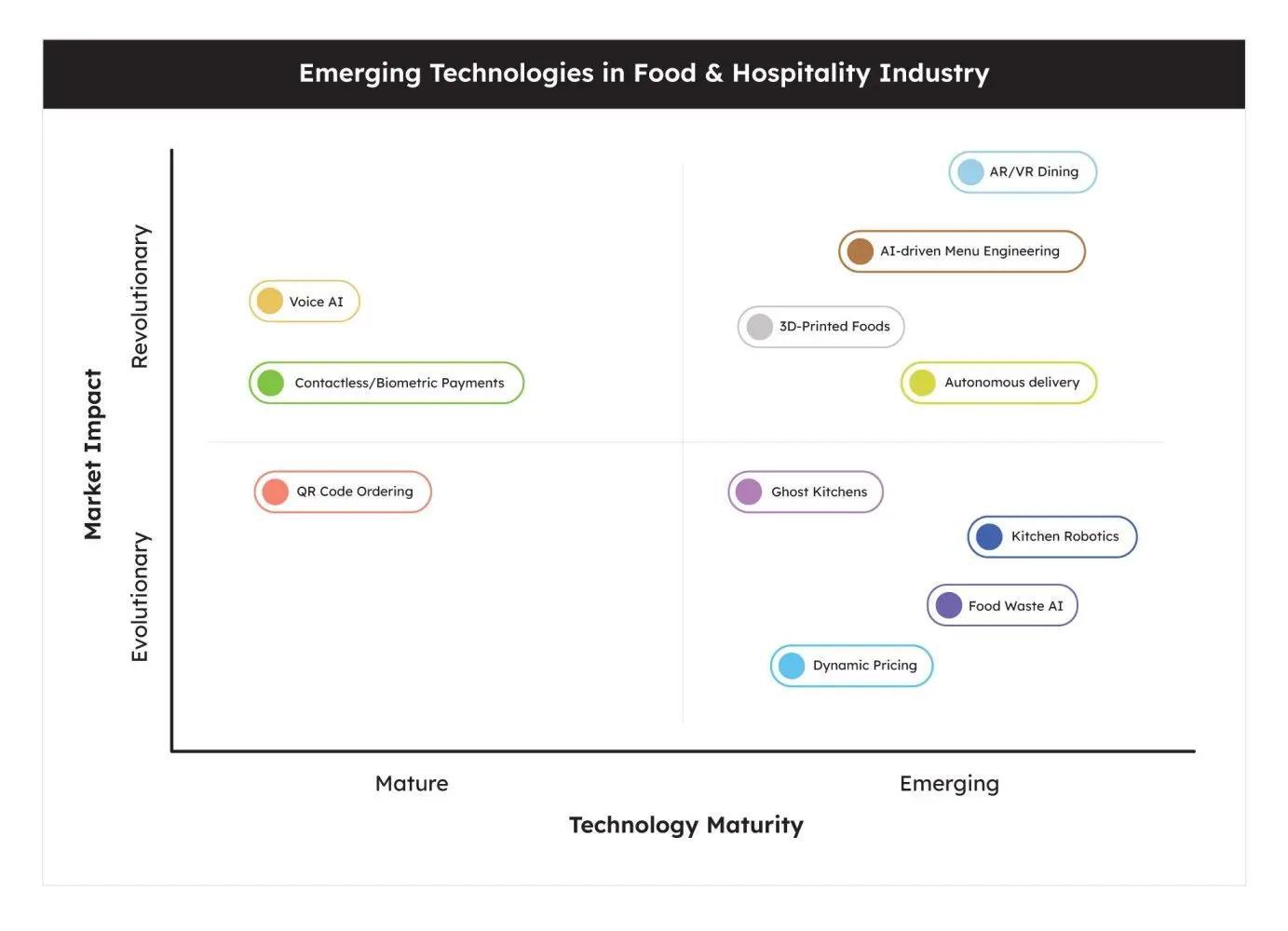
- Chart each technology on a grid:
Step 2: Categorize the Players in Your Industry
Next, pick a specific technology from step 1 (typically, you’re looking at the “emerging” and “revolutionary” quadrant) and map out how your competition is leveraging this technology today.
- Identify the players: Who are the top 3-8 competitors in your market?
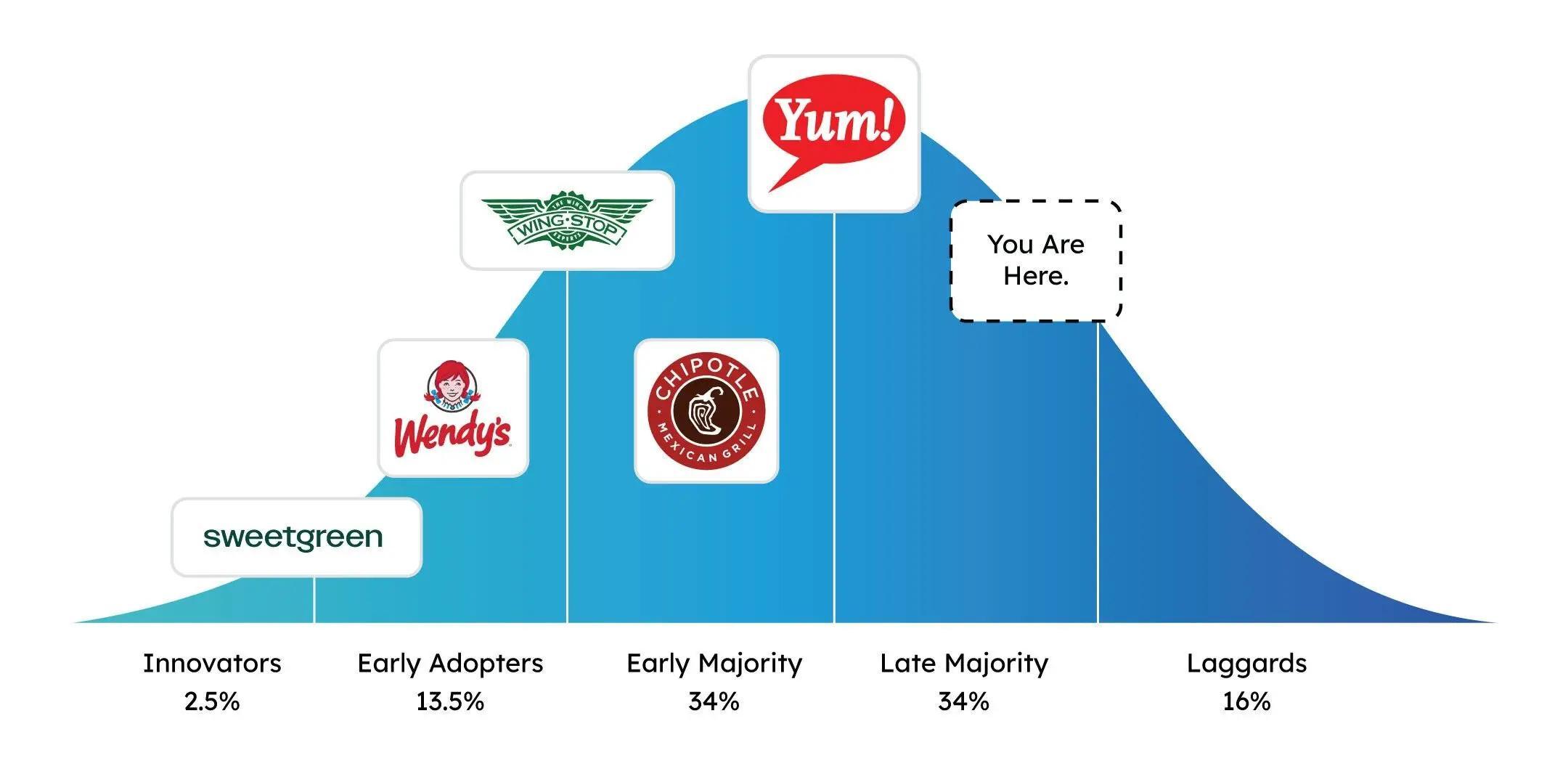
- Where do they stand?: Plot them onto a blank adoption curve as it pertains to the technology you’re investigating.
- Provide notes, identify examples or sources: This piece is tricky as it’s hard to know what’s happening inside other companies (especially when it comes to pre-launch efforts) - Links to news articles, press releases, or new product launches are all helpful context. Pulling in 3rd party reports is also helpful.
We built our curve based on leading innovators exploring “AI-Driven Menu Generation.” Check out some of our notes below:
1. Wingstop - Wingstop isn’t inventing the tech themselves, but they’re aggressively deploying AI-driven smart kitchens ahead of many competitors. They’re using real-time AI forecasting and showing a willingness to integrate tech to gain operational advantages — classic early adopter behavior.
2. Yum! Brands (Taco Bell, KFC, Pizza Hut)- Yum! Brands is a huge, scaled enterprise, so they’re rarely the very first to roll out experimental tech. But once they see market validation (and competition moving), they jump in with global force. Their partnership with NVIDIA shows they’re pushing to the mainstream edge of AI adoption, riding right into early majority territory.
3. Wendy’s - Wendy’s experimenting with AI-driven surge pricing is pretty bold — they’re moving into a space even bigger players (like McDonald’s) haven’t fully embraced yet. It’s risky and public, marking them as early adopters who are trying to seize differentiation before it becomes commonplace.
4. Sweetgreen - Sweetgreen’s “Infinite Kitchen” concept puts them at the cutting edge — these are robotic, AI-integrated operations that are still experimental for most chains. They’re behaving like innovators: building and testing new models before the broader market has figured out if they work at scale.
5. Chipotle Mexican Grill - Chipotle is piloting AI robotics (like Chippy) and AI-assembled makelines, making them an early mover — but not quite on the bleeding edge like Sweetgreen. They’re prototyping now to stay ahead of fast followers, fitting them squarely into the early adopter bucket.
Step 3: Plot Your Organization’s Position
- Plot your organization on the same curve, and be pragmatic about where you stand. Are you currently evaluating, piloting, or implementing the technology in question?
- Are you an early mover, a cautious adopter, or a laggard?
Our curve looked like this:
Step 4: So what? (Wargaming & Scenario Planning)
With your research complete, you’ll have a working model of where you stand, but the bigger question is, what should you do about it? Wargaming and scenario planning help develop your strategy for how you should react and why.
At this point, you have a framework for:
- What technologies are currently disrupting your impact, and what’s the potential impact of them on your market and competitive landscape?
- We’ve selected a single piece of tech to explore and have decided how your most important competitors are responding.
- You’ve mapped out how your organization is responding to a given technology innovation today.
For your scenario planning, you’ll want to consider two basic models:
Model 1: Early Adopters “Win” -In this scenario, you’re assuming that the technology in question continues to live up to its hype and potential. User adoption grows, and the market responds to innovations leveraging this tech. You’ll ask yourself:
- How does this impact each competitor in our analysis?
- How does this impact us, based on our position on the adoption curve
- How does this impact the macro-dynamics of our industry?
Model 2: Late Adopters “Win” -In this scenario, you’re assuming the technology in question stalls or flounders from an adoption standpoint. The hype pulls back, and most acknowledge that a given innovation didn’t live up to its potential (or perhaps it’s just before its time.) You’ll ask yourself the same question:
- How does this impact each competitor in our analysis?
- How does this impact us, based on our position on the adoption curve
- How does this impact the macro-dynamics of our industry?
You’ll plot these insights onto a simple table, and consider (or discuss as a team) which scenario best plays for you and your company, and if it makes sense to shift your position on the adoption curve. How should our company react in either scenario?
A sample analysis is below:
Analysis 1: AI-Driven Menus Take Off — Huge Industry Relevance
✅ Pros for Early Adopters (Innovators / Early Adopters)
Competitive advantage → They’ve built data pipelines, operational workflows, and customer expectations before rivals catch up.
Brand differentiation → Positioned as tech-forward, customer-centric, and innovative, attracting both talent and loyal customers.
Learning curve mastery → They’ve had time to test, fail, and refine, making them experts just as the broader industry tries to jump in.
Supply chain and cost efficiencies → They’ve already reaped savings from AI-optimized inventory, reduced food waste, and better demand forecasting.
Stronger partnerships → First-mover status often secures better vendor relationships, pilot opportunities, and preferred pricing on emerging platforms.
❌ Negative Impact for Late Adopters (Late Majority / Laggards)
Market irrelevance → Customers now expect AI-personalized experiences; late adopters risk looking old-fashioned or out of touch.
Higher cost of entry → Tech and vendor pricing may rise as demand spikes, and late entrants will pay more to get in.
Operational disadvantage → Competitors are already faster, leaner, and more data-driven, making it hard to compete.
Talent disadvantage → Top talent may flock to innovative brands, leaving late adopters struggling to hire the right people.
Lost loyalty → Once customers get used to the AI-driven convenience and personalization elsewhere, they may be hard to win back.
If I knew that this outcome was 100% guaranteed, my company should:
Rapidly build competency in this area: Good catch up strategies include finding an industry leading service provider, partner with a smaller solution company with a passionate team, or poach executive and thought leaders from our competition.
Plan and fund a “pilot” at one of our locations (or multiple locations in a small market) to quickly work out the kinks.
Consider leapfrogging public sentiment with a marketing campaign focused on making a “big bang” once the pilot begins an organization-wide roll-out.
Analysis 2: AI-Driven Menus Flop — A Fad That Fizzles
❌ Cons for Early Adopters (Innovators / Early Adopters)
Sunk costs → Millions invested in tech, hardware, integrations, and partnerships that yield little or no ROI.
Brand damage → Public perception may shift: once-seen-as-innovative brands now look impulsive or wasteful.
Operational complexity → Added systems, training, and processes become burdensome and distract from the core business.
Opportunity cost → Resources spent on AI were not spent on other, possibly more profitable, improvements (e.g., menu R&D, service quality).
Early reputational risk → Public or media narratives can flip quickly — “tech-forward” becomes “reckless experimenters” if the trend sours.
✅ Pros for Late Adopters (Late Majority / Laggards)
Resource conservation → They avoided pouring time, money, and staff attention into an ultimately unproven or unnecessary technology.
Agility & focus → While others chased trends, they stuck to fundamentals (great food, service, and pricing), retaining customer trust.
Fast-follower advantage → If some lessons from AI experimentation survive, they can cherry-pick best practices later without incurring early trial-and-error costs.
Brand positioning → They can frame themselves as practical, grounded, and customer-first, avoiding tech fads that complicate the dining experience.
Financial stability → By sidestepping risky innovation bets, they keep margins healthier and shareholders happier.
If I knew that this outcome was 100% guaranteed, my company should:
Play the “other side of the coin”: Hire away top menu planners from your competition that is leaning heavily into AI for menu strategy.
Engage marketing partners to develop an “anti-AI menu” and potentially a “Pro-privacy” marketing push (assuming it’s compatible with your brand and values)
Change in-store interactions to focus on the human, and less on the machine, consider leading with human interactions, not digital!
Conclusion: Deliberate Analysis & Strategic Planning Help You Consider Both Sides of the Curve
Building a custom adoption curve for your industry enables smarter investment decisions and ensures your business is moving at the right pace.