



Key Takeaways:
- Fast-casual brands often sacrifice their identity for speed-to-market. When your digital interface looks like everyone else’s, your food becomes a commodity, and customer loyalty vanishes the second a competitor swoops in.
- Digital friction happens when the app doesn't follow the "natural" order of a sandwich or burger build. If your online UX doesn't match the physical guest journey, you aren't just frustrating users, you’re actively depressing your Average Order Value (AOV).
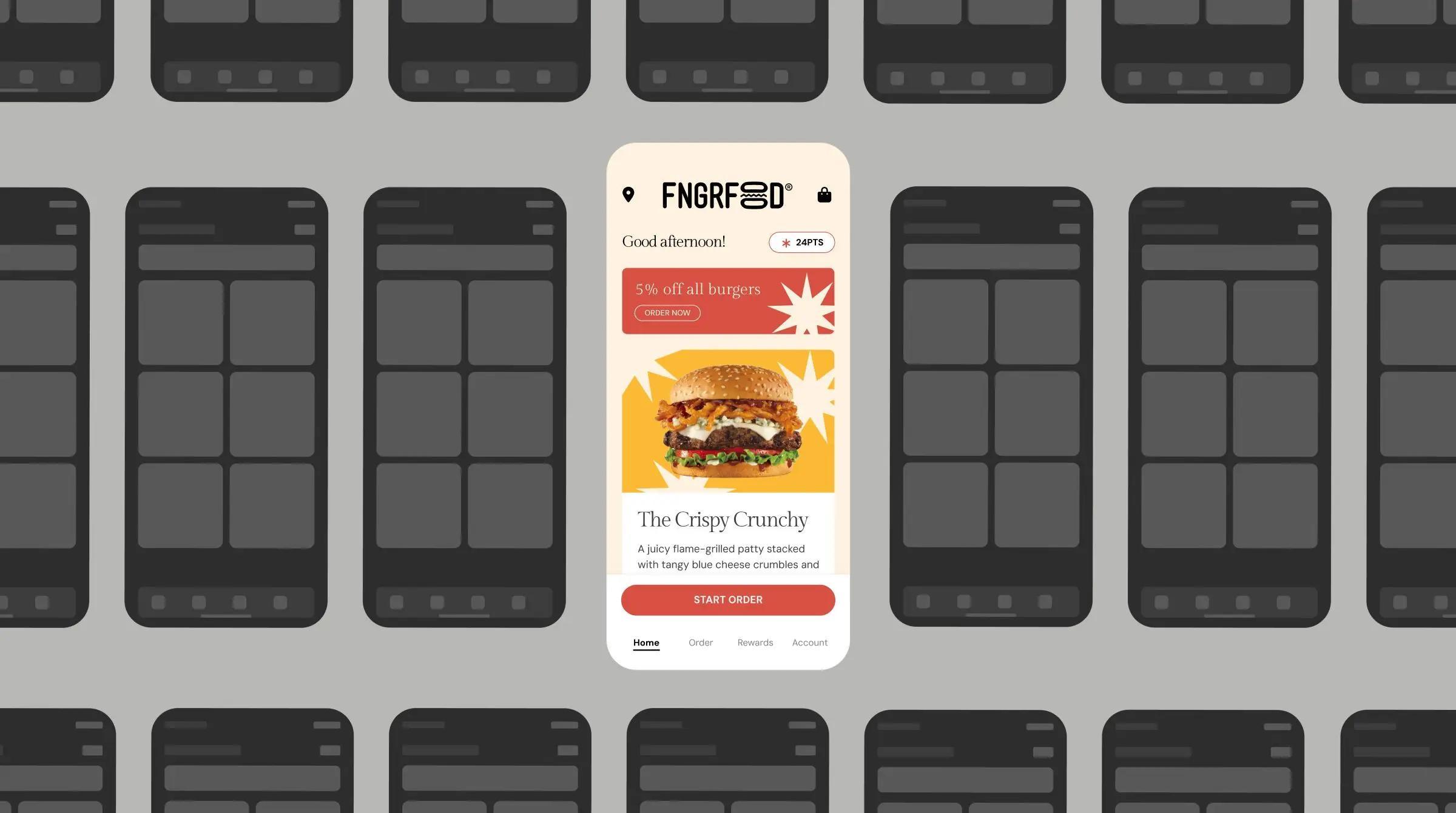
- You no longer have to choose between a rigid white-label app and a million-dollar custom build. FNGRFOOD provides the structural integrity of a proven checkout flow with the aesthetic soul of a bespoke brand experience.
- Brand sovereignty means owning the interface. By decoupling your front-end UX from your back-end POS or loyalty provider, you can swap out tech vendors without forcing your customers to learn a new UI or re-download an app.
- Success in digital ordering isn't about utility; it's about brand sovereignty. With a brand new digital experience, Hattie B’s new order app, on the FNGRFOOD platform, helps ensure that customers enjoy transacting online and keep coming back for more.
Digital ordering isn't a "nice-to-have" anymore. For some of your guests, it’s the only way they interact with you. But in the rush to get online, a lot of chains ended up looking exactly the same. Even worse, the way you order on their platforms feels nothing like ordering in one of their locations. They fell into what we call the template trap, where every brand starts to feel like a carbon copy of the next.
The problem is this. Guests are used to ordering your product in a very specific fashion. In a burger joint that means picking your entree, customizing your toppings, picking your side, and then a size for your drink. If it’s a sandwich shop it’s often bread, meat, toppings, and then condiments. Of course the devil is in the details (Can they add extra fries? Double Protein? Swap to gluten free? Add sauces on the side?)
If your digital ordering experience doesn’t match your in-store flow there’s going to be a customer disconnect, and a direct impact on your bottom line. It’s even worse if the order flow is unique across multiple channels (3rd Party, Web, Mobile, and in-store.) Instead of being a moment of delight, your ordering experience becomes a sterile, forgettable experience that creates a bad customer experience and discourages users from returning to that channel.
At Moxie Labs, we believe that when you compromise on your digital brand, the impact isn’t just aesthetic, you're losing customers. Short-term this impacts AOV, and long-term just kills repeat brand engagement and customer loyalty. So how do you fix it?
The False Choice: White-Label vs. Custom Build
For years, restaurant operators believed they only had two paths. Path A was the white-label provider: affordable and fast, but rigid and anonymous. Path B was the custom-coded build: a beautiful, bespoke masterpiece that cost seven figures and took eighteen months to get to market.
This binary is where most brands get stuck. They want the soul of a custom build but have the timeline and budget requirements of a growing enterprise. This is exactly why we developed FNGRFOOD.
FNGRFOOD introduces a third path: Conversion-Optimized UX Frameworks. We don't believe in "templates" in the traditional, static sense. Instead, we use a library of battle-tested architectural frameworks. Think of it like a high-end modular home. The foundation, the plumbing, and the structural integrity are standardized for maximum efficiency and safety, but the finishes, the layout, and the "vibe" are entirely custom. We’ve done the heavy lifting of figuring out exactly where a guest’s thumb naturally rests and how many clicks it should take to move from "Hungry" to "Check Out."
Our solution implementation teams blend UX leadership with AI-tooling to ensure that the resulting UX flow aligns with your needs, your customers expectations, and drives loyalty not frustration.
Case Study: Hattie B’s and the Digital "Coop"
When Hattie B’s Hot Chicken approached us to revitalize their digital presence, they weren't looking for a utility tool. Hattie B’s is a brand with a massive personality. They are loud, kind and hospitable, and quintessentially Nashville. A generic ordering app would have been a disservice to the "Coop Club" fans who have made the brand a national icon.
By utilizing FNGRFOOD’s flexible frameworks, Hattie B’s was able to launch a digital experience that feels like an extension of their physical restaurants. We didn't just change the colors; we matched their energy with an ordering and loyalty experience that was uniquely them.
- Brand Sovereignty: The interface uses Hattie B’s specific visual language, from the way the "Heat Levels" are displayed to the tone of the micro-copy.
- Intentional UX: While the brand identity is front and center, the ordering flows are highly optimized for the way Hattie’s guests order in-store. The frameworks ensure that the "Nashville" flair (and emphasis on spice level and sauce) never gets in the way of a lightning-fast checkout.
- Emotional Connection: By moving away from a template, Hattie B’s turned a transaction into a budding relationship. Guests don't feel like they are using a software platform, they feel like they are ordering from Hattie B's.
The Economics of Consistent Brand Experience
The "Template Trap" doesn't just hurt your brand, it hurts your conversion rates. In a world of infinite choices, friction is the enemy, but anonymity is the killer. When a guest uses a generic app, they are more likely to treat your food as a commodity. When the app experience is bespoke and immersive, it drives brand recall and customer lifetime value (CLV). It motivates your guests to create accounts, engage with your loyalty program, and build lasting relationships.
Furthermore, the FNGRFOOD backend orchestration layer means that if you’re ever in a position to switch out one of your “back of office” tools (like your ordering platform, loyalty provider, or POS system) the swap can be done behind the scenes. Your customers don’t pay the price for your ever evolving technology stack.
Conclusion: Reclaim Your Digital Front Door
If you are a multi-location operator, your app and website are valuable pieces of real estate. You wouldn't let a landlord tell you exactly what color to paint your dining room or where to put your tables. Why let a software provider do the same?
Breaking out of the Template Trap is about more than just "looking good." It is about reclaiming your margin, owning your data, and ensuring that your brand’s personality is the primary reason your guests keep coming back. With FNGRFOOD, you can have the upside of a fully custom solution without the budget and in-house team of the “big guys.”
Learn more about FNGRFOOD at www.FNGRFOOD.com.