Adoption Intelligence: Decoding the Language of Treatment Transitions
Key Takeaways
- Adoption Signals Matter More Than Awareness: True brand momentum emerges when conversations shift from disease awareness to peer-to-peer discussions about switching and sustaining therapies.
- Treatment Transitions Reveal Hidden Friction: Social listening uncovers the real-world logistical, emotional, and clinical barriers patients face during the first critical weeks of a new therapy.
- Trust Migrates to Deep-Dive Communities: As patient communities mature, decision-making moves away from high-velocity social feeds into forums and long-form environments where credibility is earned.
- Adoption Intelligence Predicts Risk and Opportunity: Monitoring transition language helps brands identify information gaps, anticipate discontinuation, and uncover competitive weaknesses before they appear in traditional data.
Specialized social listening enables smaller brands to out-maneuver larger competitors by reacting to real patient behavior at the speed of adoption.
In the lifecycle of a pharmaceutical product, the transition from launch to market maturity is often measured by prescription volume and market share. However, at Moxie, we believe there is a deeper, more predictive metric that resides within the digital landscape: Adoption Intelligence.
While general disease awareness lays the foundation, the shift toward high-stakes, peer-to-peer dialogue about treatment transitions signals a brand's true trajectory. By 2026, social listening has matured from a simple "pulse check" into a strategic engine that decodes how patients and caregivers navigate the move from legacy therapies to modern alternatives.
Moving Beyond Awareness
Traditional digital marketing often focuses on the "Awareness" phase—ensuring stakeholders recognize a condition and a brand. However, social listening data reveals that as a community matures, the conversation shifts into a critical adoption phase. In this stage, patients and physicians flee high-velocity social snippets in favor of deep-dive, long-form environments to seek logistical and clinical advice.
This migration of trust often results in massive surges in forum and community engagement. In these spaces, the dialogue moves past whether a drug simply works to how it integrates into a life already burdened by complex chronic conditions and the logistical realities of long-term care.
The Language of the Transition
Adoption Intelligence allows brands to listen to the specific "friction points" discussed during treatment switches across any therapeutic area. Rather than just tracking clinical data, brands can monitor how patients discuss the practical realities of their therapy.
By monitoring these matured dialogues, companies can:
- Identify Information Gaps: Uncover exactly where patients feel unsupported or confused during the critical first 30 days of a new therapy.
- Refine Medical Education: Use granular insights from community platforms to empower advocacy groups with an "innovation story" that addresses real-world patient needs.
- Predict Discontinuation: Understand the specific "rants" regarding tolerability or side effects that contribute to negative sentiment and lead to higher dropout rates.
- Analyze Competitive Openings: Identify deep-seated dissatisfaction with legacy competitor logistics to position modern alternatives more effectively.
Engineering the Pivot to Adoption
For the small and mid-sized pharma brand, this intelligence is the key to out-maneuvering larger competitors by observing (but ideally participating) in the high-stakes conversations that drive long-term adoption. Moxie fuels this strategic pivot through our Quarterly Social Listening Services, which transform raw social data into actionable Adoption Intelligence.
Our methodology goes beyond simple keyword tracking by deploying a focused framework that isolates branded conversation from broader disease-state and competitor sentiment. We provide a comprehensive read-out of the truth layer—using sentiment breakdowns and keyword drivers to identify the clinical halo effect protecting your brand. By delivering these deep-dive reports every 90 days, we enable your team to react at the speed of the patient, refining your unbranded education and tactical execution based on real-world evidence only peer-to-peer communities can provide.
Stop guessing why patients are switching (or why they’re not.) Let Moxie perform a digital 'friction audit' of your current therapy to uncover the logistical gaps your competitors are already exploiting. Contact us now.
The Performance Pivot: Why Small Pharma Can’t Afford "Generalist" Digital Marketing
Key Takeaways
- Efficiency Is the Real Competitive Advantage: For small and mid-sized pharma brands, limited budgets mean every digital dollar must work harder. Performance—not scale—is what separates growth from stagnation.
- Generalist Digital Marketing Drains Budget: One-size-fits-all digital execution leads to wasted spend, misaligned messaging, and underperforming campaigns in regulated environments.
- Specialization Unlocks Precision: Dedicated digital partners bring the technical depth needed to optimize paid search, paid social, CRM, and search with surgical accuracy.
- Performance Requires Systems, Not Campaigns: High-performing brands move beyond “batch and blast” tactics toward integrated, behavior-driven journeys that support patients and HCPs over time.
- Focus Enables Smaller Brands to Out-Maneuver Giants: By prioritizing efficiency, intent, and data-driven execution, small pharma can compete—and win—without blockbuster budgets.
When you are operating with a fraction of the budget of a "Big Pharma" blockbuster, you cannot afford to treat your digital marketing as a secondary concern of a traditional Agency of Record.
While a creative Agency of Record is brilliant at the "Big Idea," expecting them to manage complex digital execution alongside brand strategy, high-science messaging, and medical writing often leads to a "generalist" approach to digital. To win, mid-sized brands must move toward a Performance Pivot: utilizing a specialized digital partner that focuses exclusively on the technical nuance of digital work, prioritizing data-driven execution over broad-stroke creative.
Unsure if your AOR is bringing the latest thinking to your digital execution? Dig into these four areas to identify inefficiencies.
1. Paid Search: Moving from "Broad Reach" to "Surgical Precision"
For a brand with a limited footprint, bidding on broad, high-volume keywords is a quick way to deplete a budget with little to show for it.
- The Problem: Traditional Agencies of Record often manage "autopilot" campaigns that bid on expensive, generic terms already dominated by massive competitors or general health publishers.
- The Management Shift: A specialized digital partner manages the alignment between ad copy and intent-specific landing pages. By focusing on "Long-Tail" search queries—the specific, multi-word questions that patients and physicians actually ask—you can lower your acquisition costs and secure a higher ad rank than competitors spending significantly more.
2. Paid Social: Navigating the Compliance-Performance Paradox
Social media is where most pharmaceutical digital campaigns go to die in committee. The challenge of fitting regulatory requirements and safety information into a fast-moving, character-limited feed often leads generalist agencies to play it too safe—resulting in ads that fail to engage.
- The Strategy: Manage the "Compliance-Performance Paradox" through Modular Content Design. This involves architecting social units that are built for compliance from the first pixel. By using technical frameworks that support interactive safety disclosures, brands can meet rigorous requirements without sacrificing the creative hook that drives engagement.
- Why it matters: In the small-to-mid-sized space, every social touchpoint needs to be an engine for conversion and education, not just a "brand awareness" box to check.
3. CRM & Email: From "Batch and Blast" to Behavioral Journeys
Many mid-sized brands treat email as a digital brochure—sent once a month to a massive, unsegmented list. This results in high unsubscribe rates and missed opportunities for patient support.
- The Strategy: Transition to Trigger-Based Orchestration. A specialized partner manages the data flow between digital touchpoints and the CRM. If a user interacts with a specific resource but fails to take the next step, the system should be managed to automatically trigger the relevant follow-up—whether it's an educational resource or a support tool.
- The Management Shift: This isn't just "sending emails"; it's managing a Customer Support Ecosystem. For a smaller brand, this high-touch, automated care builds the loyalty that larger competitors try to buy with massive television spends.
4. SEO & AEO: Winning the Search for Authority in a Hybrid World
Search algorithms and user behaviors have evolved. In 2026, it is no longer enough to optimize only for a Google results page. You must also optimize for the Large Language Models (LLMs) and AI agents that now mediate the patient and physician journey.
- The Strategy: Evolve your search strategy to encompass both Search Engine Optimization (SEO) and Answer Engine Optimization (AEO). This means managing your clinical depth to appeal to both human audiences and AI scrapers. A specialized partner ensures your site is technically structured for "Featured Snippets" and AI-driven summaries by prioritizing Search Intent over simple keywords.
- The Dual-Audience Goal: When a physician asks an AI agent about a specific mechanism of action (MOA) or a patient searches for therapy science, your brand must be the definitive source. Outranking generalist blogs requires a technical structure (such as schema markup and structured data) that allows AI "Answer Engines" to cite your clinical expertise as the primary authority.
The 2026 Mandate: Efficiency is Your Edge
As we move through 2026, small and mid-sized pharma companies cannot afford the "digital tax" that comes with a generalist approach. The landscape is too complex, and the cost of engagement is too high to rely on a traditional Agency of Record that treats digital as an "add-on" to a broader creative remit.
Managing your tactical execution through a dedicated digital specialist allows you to out-maneuver the giants. It ensures that every search, every social post, and every email is a high-precision instrument designed for one thing: getting your treatment and information to the people who need it most.
If you want to hear more about how Moxie is helping small and mid-sized pharmaceutical companies win, contact us today.
Pharma’s Digital Bottleneck: Why Speed & Agility Are the Next Competitive Edge
Key Takeaways
- Speed Is the New Competitive Advantage: In today’s pharma landscape, the ability to move quickly with compliant digital messaging is just as critical as the science behind the molecule.
- The Real Bottleneck Isn’t MLR: Delays are driven by pre-work, procurement, and misaligned decision-making long before content ever reaches review—creating months of avoidable latency.
- Strategic Whiplash Is a Hidden Cost: Slow workflows force constant pivots, drain team morale, and leave high-value work obsolete before it ever reaches the market.
- Modular Content Unlocks True Agility: Breaking messaging into pre-approved, reusable components allows teams to respond to shifting priorities in days instead of weeks.
- Parallel Reviews Beat Linear Processes: Running medical, legal, and brand reviews simultaneously reduces friction, resolves conflicts faster, and keeps campaigns aligned with real-time market conditions.
In the world of healthcare marketing, “slow and steady” just doesn’t cut it anymore. While other industries have embraced rapid iteration, pharma is stuck with a linear, fragmented workflow that takes months to get anything done. Compound that with the fact that the competitive landscape is moving quicker than ever, and that means that most marketers are left in the dust.
The lesson is clear: the marketers who can execute more quickly will see outsized performance compared to their slower competitors.
You Can’t Afford “Strategic Whiplash”
The number one decelerator of your digital execution pipeline is “strategic whiplash.” It’s the last-minute changes to your positioning, messaging, or creative once you’re already in execution mode.
Not only does it impact your short-term execution, but it also creates downstream confusion, demoralizes the team, and makes it even harder to quantify the impact of your marketing. It creates a soul-crushing cycle:
- The Pivot Trap: Teams are forced to abandon pre-established strategic frameworks, known user personas, or in-flight messaging due to the whims of an executive two levels up.
- The Hustle Tax: While usually well intentioned, the team moving “too fast” to respond to the pivot trap water down the strategy, confuse the message, and create mis-alignment with other in-flight marketing or sales efforts.
- The Morale Factor: Once the strategic rug is pulled, teams need to work 3 times as hard for each activation. Nothing is sacred and they’re consistently revisiting their messaging (and even creative) to optimize for an unclear go-to-market approach.
Managing the Bottleneck: A Blueprint for Agility
Let’s agree to stop blaming the Medical, Legal and Regulatory (MLR) review cycle for the snail-like pace of our marketing initiatives. The true bottleneck is the compounding impact of strategic whiplash, and this is something we can fix!
Here’s how we’d recommend you restructure your progress to handle the need for accelerated execution without introducing additional risk:
1. Anchor (and re-anchor) your strategic imperatives up-front
Build out a core strategy and messaging deck, and ground all of your executions with pre-approved go-to-market strategies and messages. This creates better alignment with marketing leadership and MLR teams upon review and can catch “strategic drift” before it infects an entire campaign’s timeline.
2. Implement “Shift-Left” Compliance
Rather than treating compliance as a final "pass/fail" gate at the end of the line, manage it by pulling those requirements into the earliest stages of ideation. Use "pre-flight" checklists that allow creators to catch 80% of "simple" violations (like missing fair balance or unsubstantiated claims) during the draft phase. This ensures that when the MLR team finally sees the work, they are reviewing high-level strategy, not typos.
3. Transition to Modular Content Frameworks
While "Atomic Design" is a familiar term in web development, pharma requires a more nuanced Modular Content Framework. This isn't just about UI components; it’s about breaking down regulated messaging into its smallest compliant units.
Instead of reviewing every individual banner or email as a unique masterpiece, manage a library of pre-approved "content blocks"—headlines, claims, and legal footers. These modules can be dynamically reassembled to meet a new strategic direction in days, not weeks, because the high-risk core components have already been cleared by regulatory experts.
Moving at the Speed of the Patient
The era of the "blockbuster drug" is being replaced by the era of the "personalized patient journey." In 2026, the leaders in the space will be the organizations that have eliminated the built-in latency of their operations.
Agility isn't about cutting corners or rushing the MLR team; it’s about building a robust, automated infrastructure that clears the administrative fog. This allows your clinical expertise to reach the patients who need it—before the next shift in priorities moves the goalposts again.
At Moxie, we don't just build digital products; we build the velocity your brand needs to win. Contact us today to learn more about our methodology and how we empower mid-sized pharma to out-maneuver the giants.
How Core Values Drive Our Success
Key Takeaways
- Moxie’s Proven Framework: Discover how our core values of innovation and integrity drive more predictable, high-quality results for your brand.
- The Moxie Innovation Edge: Learn how our commitment to challenging the status quo delivers the industry’s most advanced digital products.
- Your Goals, Our Priority: See why Moxie Labs’ client-centric culture ensures your business objectives remain our primary strategic driver.
- Adaptive Growth Strategies: Understand how Moxie’s agility helps your business pivot and scale ahead of market shifts.
- Access to Elite Talent: Benefit from a value-driven culture that attracts and retains the industry’s top digital professionals for your projects.
At Moxie Labs, a distinct set of core values serves as the fundamental driver of our operations. These principles dictate our approach to every aspect of our business, from client engagements to the execution of our daily work, shaping our strategies and decisions.
A snapshot of our values is below:
Innovation: We are always looking for new and better ways to do things. We are not afraid to challenge the status quo and take risks. This commitment to innovation has allowed us to develop some of the most innovative digital products and services in the industry.
Collaboration: We believe that the best work is done when we work together. We value the input of our clients and team members and are always looking for ways to collaborate and improve.
Integrity: We are committed to doing the right thing, even when it is difficult. We are honest and transparent in our dealings with our clients and our team members.
Client-Centricity: We are passionate about helping our clients succeed. We put their needs first and are always looking for ways to exceed their expectations.
Excellence :We strive for excellence in everything we do. We are not satisfied with mediocrity; we are always looking for ways to improve and exceed our own expectations.
Agility: We are able to adapt quickly to change, pivot when needed, and always look for new opportunities.
Continuous Improvement: We are always learning and growing. We are committed to continuous improvement, both as individuals and as a team.
Our core values are more than words on a page; they are the foundation of our company culture. They make us who we are and drive us to succeed.
How Our Core Values Drive Our Business Forward
Our core values are important not just to us as a company but also to our clients. Our clients know that when they work with Moxie Labs, they are working with a team that is passionate about their success. They know that we will go the extra mile to deliver results.
Our core values also help us to attract and retain the best talent. We are proud to be a company that is known for its strong values. This makes us an attractive employer for talented professionals who want to work for a company that they can be proud of.
Our core values are the heart and soul of Moxie Labs. They are what make us who we are and what drives us to succeed. We are proud to be a company that is built on a foundation of strong values. We believe that our values are what make us a great place to work and a great company to do business with.
How to Build Your Technology Adoption Curve
Key Takeaways
- Discover how to build an adoption curve tailored to your specific sector's unique pace of disruption.
- Learn to plot rival strategies—from "early movers" to "fast followers"—to identify your competitive gap.
- Use a pragmatic framework to categorize your organization as an innovator, cautious adopter, or laggard.
- Master scenario-planning models to prepare your business for both tech breakthroughs and industry-wide flops.
- Gain actionable steps to build internal competency, launch pilots, or pivot your brand positioning as trends shift.
Mapping the Impact of Innovation on Your Industry
In our other article, we talked about the technology adoption curve and how it can help develop your technology adoption strategy and associated tolerance for risk. This article will focus on the first step in building your organization’s technology adoption curve and how to use it.
The first step is understanding what technologies merit your attention and where a specific innovation falls on the adoption curve within your industry. While the Technology Adoption Curve provides a general framework, every industry experiences technological disruption differently. Some industries—like software and consumer electronics—move rapidly, while others—like healthcare and manufacturing—are more deliberate in their evolution.
Here’s your step-by-step guide:
Step 1: Identify Emerging Technologies in Your Sector
The first step is identifying the technology worth your focused analysis. What's happening in your space, and how disruptive could it be?
- Track industry trends, competitor adoption, and emerging R&D efforts.
- Leverage market research reports, startup activity, and academic research to pinpoint innovations on the horizon.
- Use tools like Google Trends, patent databases, and Gartner’s Hype Cycle to assess technology maturity.
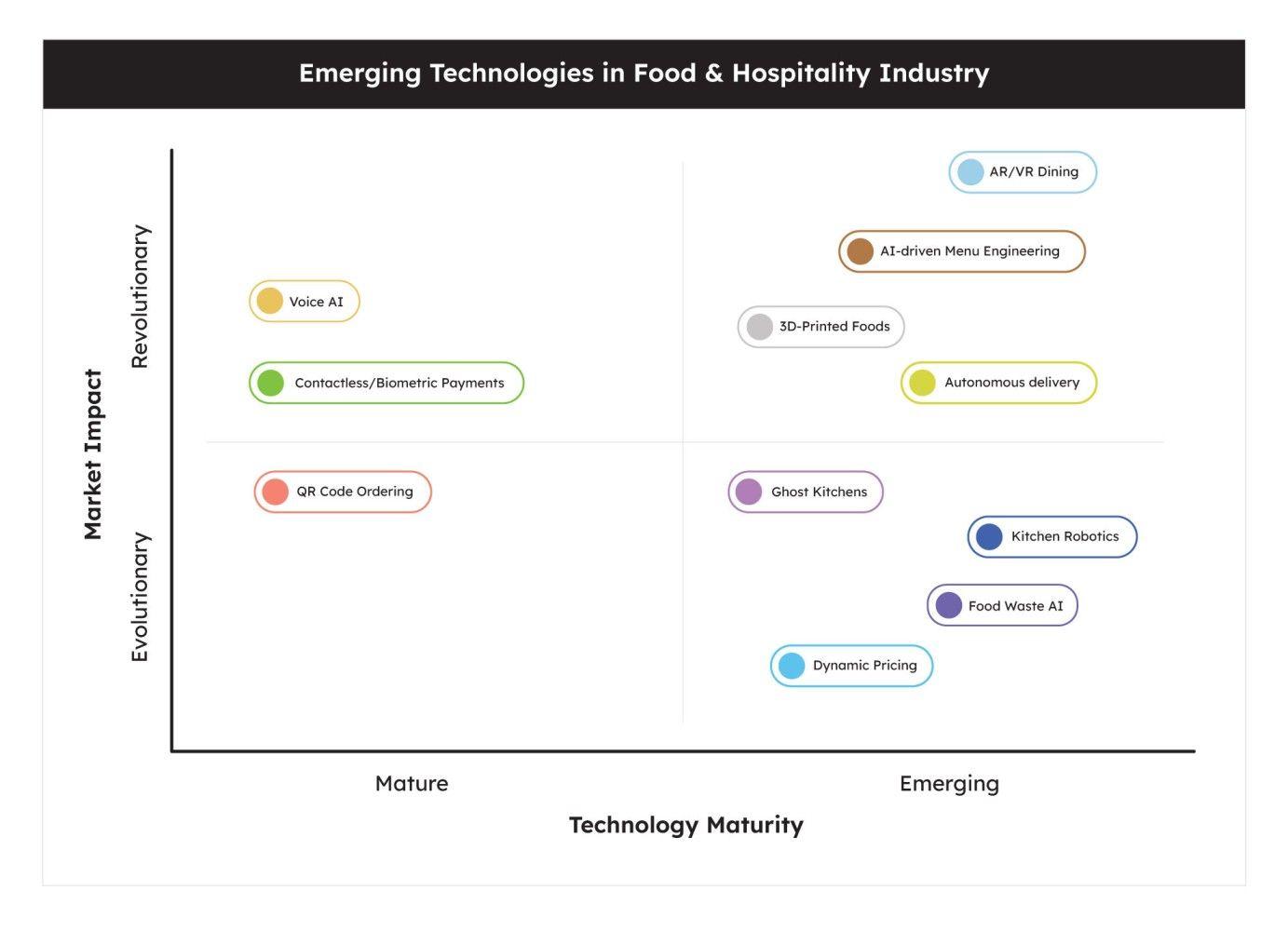
- Chart each technology on a grid:
Step 2: Categorize the Players in Your Industry
Next, pick a specific technology from step 1 (typically, you’re looking at the “emerging” and “revolutionary” quadrant) and map out how your competition is leveraging this technology today.
- Identify the players: Who are the top 3-8 competitors in your market?
- Where do they stand?: Plot them onto a blank adoption curve as it pertains to the technology you’re investigating.
- Provide notes, identify examples or sources: This piece is tricky as it’s hard to know what’s happening inside other companies (especially when it comes to pre-launch efforts) - Links to news articles, press releases, or new product launches are all helpful context. Pulling in 3rd party reports is also helpful.
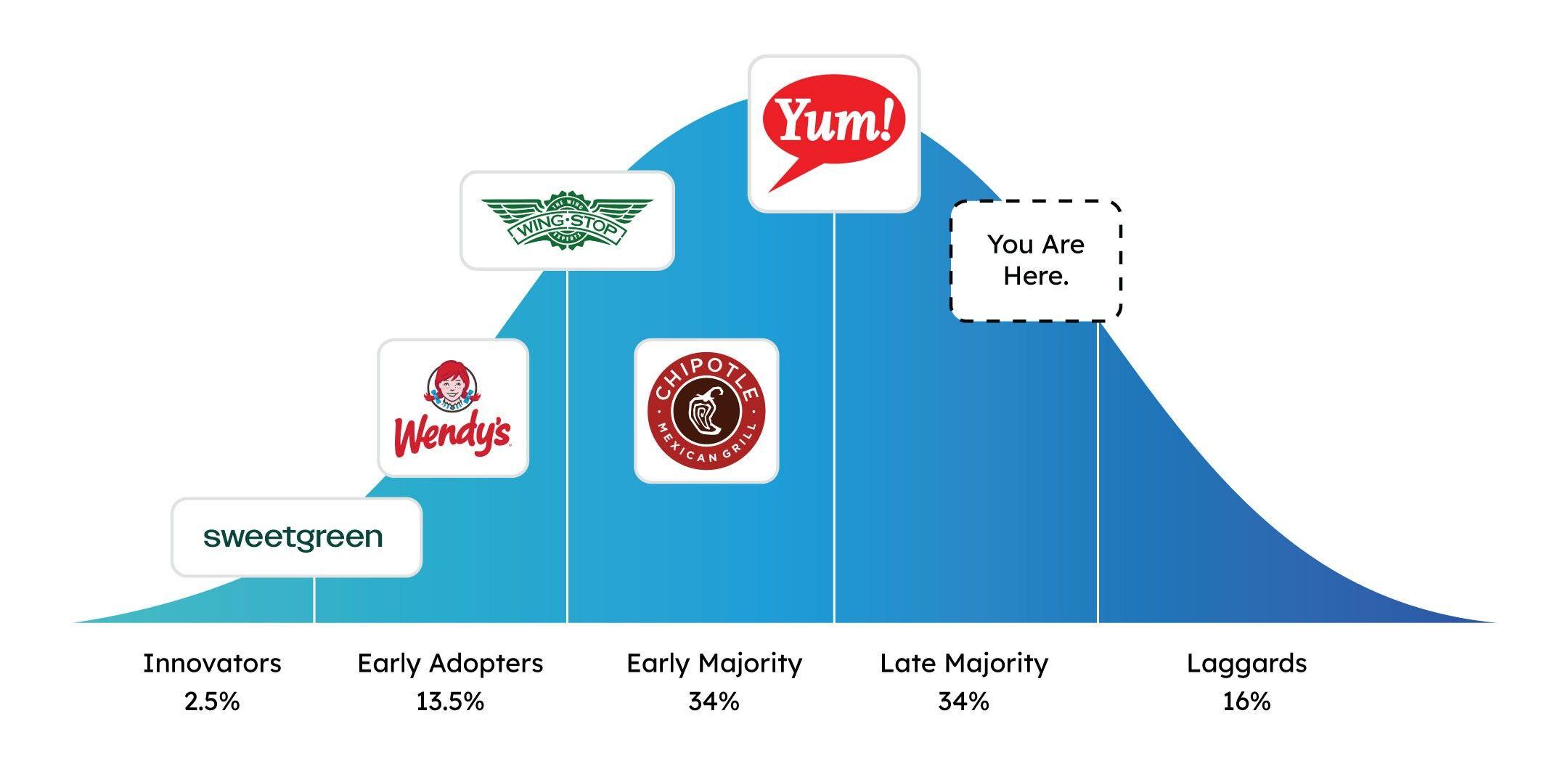
We built our curve based on leading innovators exploring “AI-Driven Menu Generation.” Check out some of our notes below:
1. Wingstop - Wingstop isn’t inventing the tech themselves, but they’re aggressively deploying AI-driven smart kitchens ahead of many competitors. They’re using real-time AI forecasting and showing a willingness to integrate tech to gain operational advantages — classic early adopter behavior.
2. Yum! Brands (Taco Bell, KFC, Pizza Hut)- Yum! Brands is a huge, scaled enterprise, so they’re rarely the very first to roll out experimental tech. But once they see market validation (and competition moving), they jump in with global force. Their partnership with NVIDIA shows they’re pushing to the mainstream edge of AI adoption, riding right into early majority territory.
3. Wendy’s - Wendy’s experimenting with AI-driven surge pricing is pretty bold — they’re moving into a space even bigger players (like McDonald’s) haven’t fully embraced yet. It’s risky and public, marking them as early adopters who are trying to seize differentiation before it becomes commonplace.
4. Sweetgreen - Sweetgreen’s “Infinite Kitchen” concept puts them at the cutting edge — these are robotic, AI-integrated operations that are still experimental for most chains. They’re behaving like innovators: building and testing new models before the broader market has figured out if they work at scale.
5. Chipotle Mexican Grill - Chipotle is piloting AI robotics (like Chippy) and AI-assembled makelines, making them an early mover — but not quite on the bleeding edge like Sweetgreen. They’re prototyping now to stay ahead of fast followers, fitting them squarely into the early adopter bucket.
Step 3: Plot Your Organization’s Position
- Plot your organization on the same curve, and be pragmatic about where you stand. Are you currently evaluating, piloting, or implementing the technology in question?
- Are you an early mover, a cautious adopter, or a laggard?
Our curve looked like this:
Step 4: So what? (Wargaming & Scenario Planning)
With your research complete, you’ll have a working model of where you stand, but the bigger question is, what should you do about it? Wargaming and scenario planning help develop your strategy for how you should react and why.
At this point, you have a framework for:
- What technologies are currently disrupting your impact, and what’s the potential impact of them on your market and competitive landscape?
- We’ve selected a single piece of tech to explore and have decided how your most important competitors are responding.
- You’ve mapped out how your organization is responding to a given technology innovation today.
For your scenario planning, you’ll want to consider two basic models:
Model 1: Early Adopters “Win” -In this scenario, you’re assuming that the technology in question continues to live up to its hype and potential. User adoption grows, and the market responds to innovations leveraging this tech. You’ll ask yourself:
- How does this impact each competitor in our analysis?
- How does this impact us, based on our position on the adoption curve
- How does this impact the macro-dynamics of our industry?
Model 2: Late Adopters “Win” -In this scenario, you’re assuming the technology in question stalls or flounders from an adoption standpoint. The hype pulls back, and most acknowledge that a given innovation didn’t live up to its potential (or perhaps it’s just before its time.) You’ll ask yourself the same question:
- How does this impact each competitor in our analysis?
- How does this impact us, based on our position on the adoption curve
- How does this impact the macro-dynamics of our industry?
You’ll plot these insights onto a simple table, and consider (or discuss as a team) which scenario best plays for you and your company, and if it makes sense to shift your position on the adoption curve. How should our company react in either scenario?
A sample analysis is below:
Analysis 1: AI-Driven Menus Take Off — Huge Industry Relevance
✅ Pros for Early Adopters (Innovators / Early Adopters)
Competitive advantage → They’ve built data pipelines, operational workflows, and customer expectations before rivals catch up.
Brand differentiation → Positioned as tech-forward, customer-centric, and innovative, attracting both talent and loyal customers.
Learning curve mastery → They’ve had time to test, fail, and refine, making them experts just as the broader industry tries to jump in.
Supply chain and cost efficiencies → They’ve already reaped savings from AI-optimized inventory, reduced food waste, and better demand forecasting.
Stronger partnerships → First-mover status often secures better vendor relationships, pilot opportunities, and preferred pricing on emerging platforms.
❌ Negative Impact for Late Adopters (Late Majority / Laggards)
Market irrelevance → Customers now expect AI-personalized experiences; late adopters risk looking old-fashioned or out of touch.
Higher cost of entry → Tech and vendor pricing may rise as demand spikes, and late entrants will pay more to get in.
Operational disadvantage → Competitors are already faster, leaner, and more data-driven, making it hard to compete.
Talent disadvantage → Top talent may flock to innovative brands, leaving late adopters struggling to hire the right people.
Lost loyalty → Once customers get used to the AI-driven convenience and personalization elsewhere, they may be hard to win back.
If I knew that this outcome was 100% guaranteed, my company should:
Rapidly build competency in this area: Good catch up strategies include finding an industry leading service provider, partner with a smaller solution company with a passionate team, or poach executive and thought leaders from our competition.
Plan and fund a “pilot” at one of our locations (or multiple locations in a small market) to quickly work out the kinks.
Consider leapfrogging public sentiment with a marketing campaign focused on making a “big bang” once the pilot begins an organization-wide roll-out.
Analysis 2: AI-Driven Menus Flop — A Fad That Fizzles
❌ Cons for Early Adopters (Innovators / Early Adopters)
Sunk costs → Millions invested in tech, hardware, integrations, and partnerships that yield little or no ROI.
Brand damage → Public perception may shift: once-seen-as-innovative brands now look impulsive or wasteful.
Operational complexity → Added systems, training, and processes become burdensome and distract from the core business.
Opportunity cost → Resources spent on AI were not spent on other, possibly more profitable, improvements (e.g., menu R&D, service quality).
Early reputational risk → Public or media narratives can flip quickly — “tech-forward” becomes “reckless experimenters” if the trend sours.
✅ Pros for Late Adopters (Late Majority / Laggards)
Resource conservation → They avoided pouring time, money, and staff attention into an ultimately unproven or unnecessary technology.
Agility & focus → While others chased trends, they stuck to fundamentals (great food, service, and pricing), retaining customer trust.
Fast-follower advantage → If some lessons from AI experimentation survive, they can cherry-pick best practices later without incurring early trial-and-error costs.
Brand positioning → They can frame themselves as practical, grounded, and customer-first, avoiding tech fads that complicate the dining experience.
Financial stability → By sidestepping risky innovation bets, they keep margins healthier and shareholders happier.
If I knew that this outcome was 100% guaranteed, my company should:
Play the “other side of the coin”: Hire away top menu planners from your competition that is leaning heavily into AI for menu strategy.
Engage marketing partners to develop an “anti-AI menu” and potentially a “Pro-privacy” marketing push (assuming it’s compatible with your brand and values)
Change in-store interactions to focus on the human, and less on the machine, consider leading with human interactions, not digital!
Conclusion: Deliberate Analysis & Strategic Planning Help You Consider Both Sides of the Curve
Building a custom adoption curve for your industry enables smarter investment decisions and ensures your business is moving at the right pace.
What is the “Technology Adoption Framework” and Why Does It Matter?
Key Takeaways
- Understand the five stages of the Technology Adoption Curve—from Innovators to Laggards—to predict how new tech will spread through your industry.
- Learn how early adoption drives market differentiation, operational efficiency, and higher employee morale by using the industry’s best tools.
- Review real-world cautionary tales of market leaders who failed to pivot, illustrating why technological hesitation can lead to permanent loss of market share.
- Discover how operating on the "left side" of the curve fuels innovation, while the "right side" optimizes capital allocation and market dominance.
- Prepare for a structured "Tech Adoption Audit" to determine where your company currently sits and where it needs to be to thrive.
In today’s fast-moving digital landscape, companies are faced with a crucial question: When should we adopt the newest technology? Too early, and the risks of unproven solutions could be costly. Too late, and competitors may have already built an insurmountable advantage. The key to answering this question lies in understanding the Technology Adoption Framework, a methodology that helps to explain how innovation spreads within a given industry segment and the different strategies corporations can use to help navigate disruptive technology shifts.
Here, we’ll break down the Technology Adoption Framework, examine real-world examples of its impact, and set the stage for how businesses can strategically approach digital transformation.
It starts with Understanding The Technology Adoption Curve
The Technology Adoption Curve is based on Everett Rogers 'Diffusion of Innovations model, which explains how new ideas, technologies, and behaviors spread through a population. The model divides adopters into five categories:
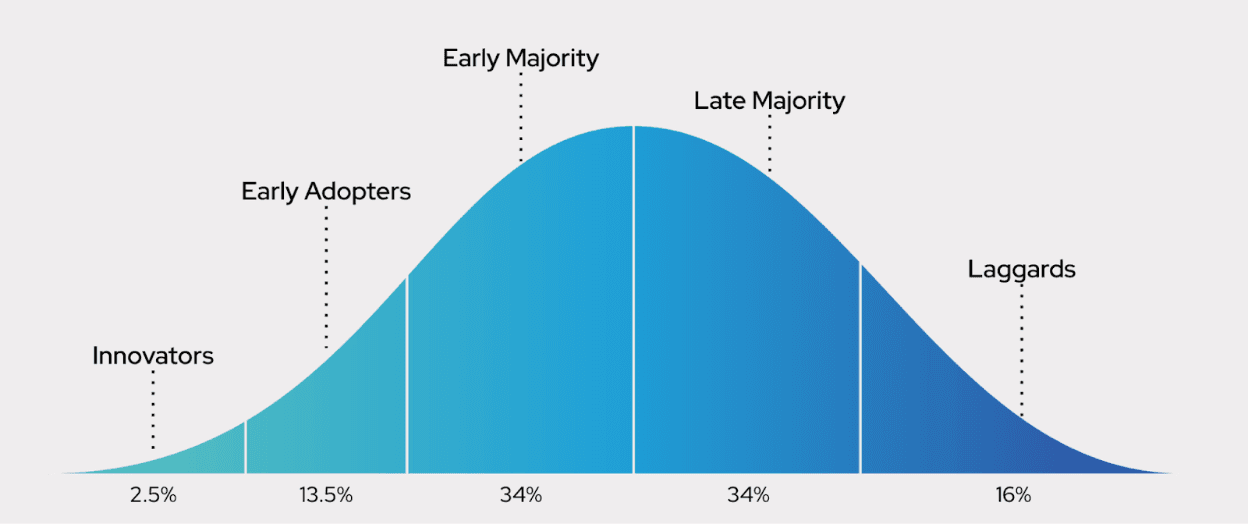
- Innovators (2.5%)– The trailblazers who experiment with cutting-edge technology, often before it’s fully tested or commercially viable.
- Early Adopters (13.5%)– Visionary leaders who see potential and move quickly to integrate new technology, often gaining the first-mover advantage.
- Early Majority (34%)– Pragmatic adopters who embrace new technology once it’s proven and widely accepted.
- Late Majority (34%)– Conservative adopters who wait until a technology is fully mainstream and risk-free.
- Laggards (16%)– Those who resist change and adopt new technology only when absolutely necessary.
For businesses, understanding where they fall on this curve isn’t just an academic exercise—it’s a crucial factor in determining long-term success. Companies that consistently operate on the left side of the curve (Innovators and Early Adopters) often reap first-mover advantages over their competitors. Those more comfortable on the right side of the curve (Early & Late Majority) are better at predictive capital allocation and extending existing market dominance.
How Early Adoption Can Create Competitive Advantage
Early adoption of disruptive technology isn’t just about staying trendy—it’s about securing a sustainable competitive advantage. Here’s why:
- Market Differentiation– Being among the first to leverage new technology allows companies to create unique customer experiences that competitors can’t immediately replicate.
- Operational Efficiency– Early adopters often gain productivity and cost advantages before the rest of the industry catches up.
- Customer Loyalty & Brand Perception– Companies seen as innovators attract tech-savvy customers who value cutting-edge solutions.
- Data & Learning– The earlier an organization adopts a new technology, the more time it has to refine and optimize its implementation.
- Culture & Morale - The best employees want to work with the best tools, and will find professional opportunities that allow them to do so!
Examples of Early Adoption in Action
- Amazon and Cloud Computing– In the early 2000s, Amazon adopted and pioneered cloud computing before most enterprises even understood its potential. The result? AWS (Amazon Web Services) became the backbone of the internet, generating billions in revenue.
- Apple and the Smartphone Revolution– Apple wasn’t the first to create a smartphone, but by aggressively innovating with the iPhone in 2007, they defined the modern smartphone era. While competitors scrambled to catch up, Apple set the standard for mobile technology, app ecosystems, and user experience.
- Nvidia and AI/GPUs– Nvidia initially focused on graphics cards for gaming, but they recognized the potential for GPUs in artificial intelligence and machine learning early on. By doubling down on AI acceleration, Nvidia became a dominant force in the AI revolution, with its chips now powering everything from autonomous vehicles to ChatGPT.
- Starbucks and Mobile Payments– While many retailers hesitated, Starbucks leaned into mobile payments and loyalty-driven digital experiences, creating one of the most successful mobile payment ecosystems in the world. Their early adoption of mobile ordering and AI-driven personalization keeps them ahead of competitors.
- MinuteClinic (Acquired by CVS Health in 2006)– Originally founded in 2000 in Minnesota, MinuteClinic was among the first to introduce walk-in, retail-based healthcare services staffed by nurse practitioners. They leveraged commercially available technology (online scheduling, maturing EHR platforms, integration with insurance/payor platforms) to focus on convenience, offering treatment for minor illnesses, vaccinations, and screenings inside retail stores. Once CVS acquired them, they rapidly expanded nationwide, integrating with the pharmacy chain's broader healthcare strategy.
These companies didn’t just follow trends—they actively created them. And by doing so, they built competitive advantages that their industries have spent years trying to close.
The Risk of Lagging Behind
While early adoption has clear benefits, late adoption can be devastating. Consider these examples:
- Retail Giants and E-commerce– While companies like Amazon embraced e-commerce early, major retailers hesitated. By the time they shifted online, they had lost market share that they’ll likely never recover.
- Blackberry and the App Revolution -BlackBerry (formerly RIM) was once the gold standard in business mobile communication, famous for its physical keyboard and secure email capabilities. However, it dismissed the importance of touchscreens and third-party app ecosystems, believing its core business users would remain loyal. As Apple and Android phones surged in popularity with app-driven experiences, BlackBerry’s resistance to change led to its rapid decline.
- IBM and the Personal Computer Market- IBM was an early leader in personal computers, but failed to anticipate the shift toward consumer-friendly, mass-market PCs in the 1980s and 1990s. While companies like Microsoft and Dell focused on software ecosystems and affordability, IBM stuck to high-cost enterprise solutions. They eventually sold off their PC business to Lenovo, exiting a market they once helped create.
The lesson? Technology doesn’t wait. Companies that hesitate risk not just falling behind—but becoming obsolete.
How Should Businesses Approach Technology Adoption?
So, how can companies ensure their technology adoption strategy supports their corporate goals and overarching strategic vision? While every organization’s journey will be different, a proactive approach to implementing the technology adoption framework is essential.
In the upcoming articles, we’ll explore:
- How to Build Your Technology Adoption Curve -How to map out how a given technology innovation impacts your industry.
- What is Your Corporate Technology Persona?– Understanding where your company sits on the adoption curve and how it affects growth.
- Strategies for Optimizing Technology Adoption– Tactics for efficiently identifying, testing, and scaling new technologies within your organization.
- Building your Technology Adoption Pipeline– Practical steps for businesses looking to move towards the left side of the curve.
- Getting Started: How to Perform a "Tech Adoption Audit” within your company– A structured approach to evaluating your company’s readiness for digital transformation.
The future belongs to companies that take a deliberate approach to navigating technology-driven change. Where does your company sit on the Technology Adoption Curve? And more importantly—where must it be to thrive?"
The Power of Parallel Thinking: Applying Academic Research to Real-World AI Product Development 🔬
Key Takeaways
- See how applying global academic research to AI development provides a performance edge over off-the-shelf tools.
- Understand how "pipeline" errors occur and how backend engineering prevents AI from following the wrong path.
- Learn how running eight simultaneous "thinking tracks" can increase output accuracy by up to 20%.
- Discover why custom backend architecture and "system prompts" are superior to basic chat interfaces for reliable results.
- Explore how a research-first strategy allows for the deployment of expert-level AI features ahead of market competitors.
In the commercial world, it's easy to focus only on the polished AI tools available right now. But at Moxie Labs, we believe true innovation comes from looking a step further—into the academic research being published by universities globally. We're constantly asking: "Does that really work like that? Can we make it better?"
This approach isn't just about curiosity; it’s about competitive advantage. By immediately experimenting with concepts often found in long, technical papers, we can dramatically increase the accuracy and performance of the AI solutions we build for ourselves and our clients.
The Core Problem: Why AI Goes Wrong
To understand the solution, you have to understand AI’s core vulnerability. We know AI is a statistical engine; it calculates the most likely correct thing to say next. The problem is that its initial interpretation of a prompt—the first few "thoughts" it has—can send it down the wrong path, or "pipeline," really fast.
If the AI misinterprets the prompt at the start, no matter how good the rest of its thinking is, the final output will be wrong. We needed a way to mitigate this risk.
The Academic Solution: Paratinker
We recently experimented with a research concept called Paratinker (a concept coming out of university research) that offers a fascinating solution: If the AI tends to go down the wrong path, why not run multiple "tracks" simultaneously?
Here’s the breakdown of how this academic concept works and how we've applied it:
- Multiple Starts: Instead of running the prompt once, the system starts eight different tracks (essentially eight virtual AIs) with the exact same initial prompt or task.
- Independent Thinking: Each track generates its own, complete output. Because they're running independently, some inevitably go down that "wrong pipeline."
- Crowdsourcing Accuracy: The system then collects the outputs from all eight tracks. It takes a vote, assessing what the majority of the outputs agree on as the correct answer.
The research showed that this method—taking the statistical majority answer—makes the final result up to 20% more accurate than just running a single, traditional prompt.
Applying Parallel Thinking to Our Products
The takeaway for us is profound: If the AI is essentially playing a game of probability, we need to stack the deck. We're applying this "parallel thinking" not just to our internal tools, but to the products we build.
This isn't something you can easily do on a public chatbot; it requires integrating the concept directly into the backend architecture of a product. It's about engineering the system prompt—the unchangeable set of instructions that guides the AI model.
1. The Power of Consistency
Our primary goal with prompting is to narrow the AI's scope to make it more precise. We tell it: "You are a Typescript expert" or "Only think within the framework of this codebase."
Parallel thinking complements this by ensuring that even when we hit a prompt where the AI could get confused, we still get the statistically most probable correct answer. This dramatically improves the reliability of our AI features, reducing the need for intensive human review on every single output.
2. Driving Innovation Velocity
By leveraging these cutting-edge academic insights, we're not waiting for commercial tools to catch up. We're implementing research that allows us to build faster, more accurate products right now. This is a critical part of our strategy to always lead with AI innovation, giving us a powerful, built-in advantage over competitors who rely solely on off-the-shelf solutions.
For us, the boundary between academic research and commercial product development is nonexistent. Staying curious and constantly experimenting is the key to building the next generation of AI solutions.
The Art of the Prompt: Our 5 Rules for Getting Precision and Accuracy from AI 🧠
Key Takeaways
- Use specific personas to narrow the AI’s knowledge and ensure your results align with domain-specific expertise.
- Provide rich context by treating the AI as a collaborative colleague to prevent vague or generic outputs.
- Request clarifying questions to force the AI to identify gaps in your instructions and confirm alignment before work begins.
- Ground the output with examples to provide clear reference points that increase the reliability of the final result.
- Modularize complex tasks by breaking problems into smaller sequential steps to prevent the AI from losing logic.
When we first started integrating AI into our product development workflows at Moxie Labs, we quickly realized something important: these tools are only as smart as the questions we ask them. Simply typing a vague request yields a vague result. To get the precision and accuracy we needed for complex engineering tasks, we had to stop asking the AI and start coaching it.
We discovered that prompt engineering is less about finding a secret formula and more about being a great communicator. Here are the five key rules we use every day to narrow the AI's vast knowledge and get actionable results.
1. Narrow the World with a Persona
The AI models we use contain the entire knowledge of humanity. That's fantastic, but also paralyzing when you need a specific answer. We’ve learned that the first line of any professional prompt must narrow that world down instantly.
The Rule: Always start your prompt by defining the AI's role and expertise.
- Example: Instead of "Write this code," we use: "You are a Senior Typescript expert, highly proficient in the Vue.js framework."
This is crucial because the AI will prioritize answers, syntax, and conventions relevant to that specific domain, instantly making your results more precise and less prone to generic code.
2. Be a Conversationalist, Not a Boss
We often think of AI as a job executor, but it's far better viewed as a new colleague. It's a "really good conversationalist," but a "poor executioner" if not given enough context.
The Rule: Talk to the AI as if you were handing off a complex task to a smart person in the hallway. Give context.
- Bad Prompt: "Fix the bug in the menu." (The AI doesn't know which menu or what bug.)
- Good Prompt: "We are working on the restaurant menu API endpoint. The issue is that the pricing structure is pulling from the old database. I need you to update the service layer logic to correctly query the new items_v2 table."
If you wouldn't understand the request without more detail, the AI won't either.
3. Don't Just Ask—Ask for Questions
This rule is a game-changer for clarity. As human experts, we often suffer from the "curse of knowledge," meaning we don't know what we don't know. We forget to include critical details because they are obvious to us.
The Rule: At the end of your prompt, specifically instruct the AI to confirm your understanding.
- Example: "Before proceeding, ask me three clarifying questions to ensure you fully understand the business logic and project constraints."
This forces the AI to check for gaps in your instructions, often bringing up constraints, edge cases, or details you entirely forgot, which instantly improves the final result's accuracy.
4. Ground the AI with Examples
AI is a statistical engine, and nothing boosts its confidence and accuracy like clear reference points. We found that giving the AI an example output is one of the easiest ways to get a massive jump in quality.
The Rule: Provide at least one complete example of the desired result format.
- Example: "Here is the question I will ask. This is the expected answer format: [Show an example of the desired code structure, JSON output, or documentation style]. Now, answer my current question."
We've observed a significant jump in accuracy even with just one strong example. For longer, more complex tasks, five examples often provide the maximum value for our effort.
5. Shrink the Scope, Increase the Precision
We noticed that the more information we give the AI to process, the more chances it has to go down a wrong path. One of our technical leaders even found research showing that running the same prompt through multiple "AI tracks" and taking the majority answer increases accuracy, proving that AI often "goes down the wrong path."
The Rule: When faced with a highly complex problem, break the problem into smaller, sequential steps and only feed the AI what it needs for the current step.
We are constantly trying to be as precise as possible, but not so exact that we limit the AI's creativity. It's a delicate balance: narrow the scope just enough so the AI doesn't get overwhelmed, but not so much that you end up typing the entire solution yourself. Mastering these five rules is key to turning a powerful tool into a reliable and indispensable member of our engineering team.
Beyond Technical Prowess: Finding an Agency with the Right "Soft Skills"
Key Takeaways
- Intangible qualities like empathy and adaptability that transform a standard vendor relationship into a high-impact strategic partnership.
- Learn why communication and collaboration are the fundamental drivers of alignment and long-term project success in the digital space.
- Use targeted interview questions to uncover an agency's true commitment to integrity and transparency during difficult project setbacks.
- Evaluate how a client-centric mindset ensures your business goals remain the primary focus even when project requirements shift.
- Assess an agency's agility and dedication to continuous learning to ensure your brand stays competitive in a rapidly changing technical landscape.
In today's digital landscape, technical expertise is a given. But true partnership goes beyond code and design; it hinges on "soft skills" – the intangible qualities that foster collaboration, trust, and mutual understanding. When selecting an agency, look for these key soft skills that are embedded in their core values. At Moxie Labs, we believe our values directly translate to the crucial soft skills needed for a successful partnership.
The "Soft Skills" You Should Seek:
- Communication & Collaboration: The ability to listen, understand, and communicate effectively is paramount.
- Adaptability & Problem-Solving: Navigating the dynamic digital world requires flexibility and creative solutions.
- Empathy & Client-Centricity: Understanding your needs and priorities is essential for a truly successful partnership.
- Integrity & Trustworthiness: Building a strong foundation of honesty and transparency is crucial for long-term collaboration.
- Proactive Initiative & Continuous Learning: A drive for improvement and a willingness to embrace new ideas are vital for sustained success.
Decoding Values Through Strategic Questions:
To gauge an agency's soft skills and value alignment, ask these targeted questions during capabilities meetings:
Innovation:
- Question: "Can you share a specific example of a time you challenged a client's initial request and proposed a more innovative solution? What was the outcome?"
- Discussion: Innovation isn't just about flashy new tools. It's about a mindset that embraces creative problem-solving and a willingness to push boundaries. Seeing innovation in action means observing an agency that actively seeks opportunities to improve and optimize, even when things are working "well enough". They should be able to provide real-world examples where they took a risk, and it paid off for the client.
Collaboration:
- Question: "Describe your process for incorporating client feedback and ensuring alignment throughout a project. How do you handle disagreements?"
- Discussion: Collaboration is more than just meetings. It's about creating a transparent and inclusive environment where everyone feels heard. Observe how they address conflict, and if they value the client's input. A collaborative agency values active listening, open communication, and a willingness to adapt based on client input. You'll see this in action through regular, transparent communication, shared project management tools, and a genuine interest in your perspective.
Integrity:
- Question: "How do you handle situations where a project encounters unexpected challenges or setbacks?"
- Discussion: Integrity means being honest and transparent, even when it's difficult. It's about taking ownership of mistakes and finding solutions that prioritize the client's best interests. In practice, this translates to proactive communication, honest assessments of progress, and a commitment to fulfilling promises.
Client-Centricity:
- Question: "Tell me about a time you went above and beyond to meet a client's needs, even when it was outside the scope of the original agreement."
- Discussion: Client-centricity is about putting the client's needs first and prioritizing their success. It's about building genuine relationships and demonstrating a commitment to their long-term goals. You'll see this in action through a proactive approach, a willingness to go the extra mile, and a genuine interest in your business.
Excellence:
- Question: "How do you measure the success of your projects, and what steps do you take to ensure quality?"
- Discussion: Excellence is about a commitment to high standards and a relentless pursuit of improvement. It's about delivering work that exceeds expectations and demonstrates a passion for quality. You'll see this through a meticulous attention to detail, a rigorous quality assurance process, and a commitment to continuous improvement.
Agility:
- Question: "Describe a situation where a project's requirements changed significantly mid-stream. How did you adapt?"
- Discussion: Agility is about being able to adapt quickly to changing circumstances. It's about being flexible, responsive, and able to pivot when necessary. This is shown by the ability to quickly re-prioritize, re-allocate resources, and adjust project timelines without sacrificing quality.
Continuous Improvement:
- Question: "How does your agency stay up-to-date with the latest industry trends and technologies? What steps do you take to improve your team's skills?"
- Discussion: Continuous improvement is about a commitment to learning and growth. It's about embracing new ideas and technologies and constantly seeking ways to improve processes and outcomes. You'll see this through a culture of learning, regular training and development, and a willingness to experiment with new approaches.
By focusing on these "soft skills" and asking the right questions, you can find an agency that not only delivers exceptional technical results but also provides a collaborative, supportive, and trustworthy partnership.
At Moxie, we strive to live these values every day. Want to learn more? Check us out at www.MoxieLabs.co
Bridging the Gap: Why AI is an Assistant for the Knowledgeable, Not a Replacement for the New
Key Takeaways
- AI amplifies expertise, it doesn’t replace it. The most productive teams pair AI with deep domain knowledge, not in place of it.
- Small gaps, great results: AI excels when assisting skilled professionals who already understand the context and logic behind their work.
- Large gaps, poor results: Without foundational knowledge, AI lacks the judgment to make accurate or strategic decisions.
- Human oversight is essential. Experts act as quality control—catching conceptual errors and maintaining alignment with business goals.
- "Pre-work" defines success. The best outcomes come from teams who document logic, constraints, and workflows before prompting AI.
- Context drives consistency. Only human experts can ensure outputs align with brand, vision, and long-term strategy.
- AI as a force multiplier. Businesses see the greatest ROI when they empower knowledgeable teams to use AI as an accelerator, not a replacement.
The hype around AI often suggests that it will automate entire roles and replace people wholesale. While AI certainly drives massive productivity gains (we've seen a nearly 50% boost on some of our engineering teams), our experience at Moxie Labs has revealed a more complex truth: AI works best when paired with existing expertise.
Simply put, AI is an accelerant for the knowledgeable, not a shortcut for the inexperienced. Understanding this distinction is crucial for any business hoping to truly harness AI's power.
The "Gap" Theory of AI
We like to think of human knowledge as a spectrum, and AI's primary function is to fill in the missing pieces. We found that AI is exceptionally good at "bridging the gap" when that gap is small.
What does that mean in practice?
- Small Gap, Great Result: If you're an experienced developer working on a large, complex project, you have a solid understanding of the architecture and business logic. When you hit a minor blocker—a specific function name, a piece of boilerplate code, or the location of a file in an old codebase—the AI can instantly fill that small gap. It acts as an omniscient pair of hands, allowing you to move forward without losing momentum.
- Large Gap, Poor Result: If a user or a very junior person has a large knowledge gap about the project, the AI struggles. As one of our technical leaders noted, AI tends to "dip" when faced with a large gap. It lacks the essential context and business understanding to make high-level decisions, often sending the user down a completely wrong path.
In short, AI performs best as a co-pilot, guided by someone who already understands the route.
Why Human Expertise is More Important Than Ever
If AI can write most of the code, what is the role of the expert? We've found that expertise is shifting from execution to oversight and strategy.
1. The Necessity of the "Sharp Eye"
AI is incredibly fast, but this speed is a double-edged sword. If you feed it flawed instructions, it will execute those flaws instantly and comprehensively.
"If you let it go down the wrong way, it will go down the wrong way really fast and it will spin completely out of control."
This means our developers act as the ultimate layer of quality control. They combine technical depth with business awareness to review and validate AI-generated work before it ever reaches production. The goal isn’t to “catch errors in real time,” but to identify conceptual or architectural mistakes before they’re committed to code.
2. Focus on "Pre-Work"
The bulk of the human work now happens before the AI is ever prompted. We must rigorously define all constraints, document the business logic, and break down the task into sequential steps. This "pre-work" ensures the AI has a tight, accurate sandbox to operate in. The result is a dual benefit: excellent documentation for the human team and accurate input for the AI.
3. Consistency and Context
Only a human expert can ensure that the AI's output is consistent with the project's long-term vision, brand style, and company standards. The AI knows how to code, but the human knows why and how that code must be applied within a specific context.
The Takeaway for Innovation
We use AI to empower our experts to be more creative, more strategic, and more productive. It’s an assistant that handles the drudgery, freeing our best people to focus on architectural challenges, complex logic, and market-defining innovation.
To truly lead with AI, businesses must invest in their people before their platforms. The companies seeing real impact aren’t the ones chasing every new tool.They’re the ones cultivating teams who understand how to use those tools strategically. AI multiplies expertise, not potential, so your return on AI depends directly on how well your people understand the systems, data, and logic behind your products.
In short: empower the experts first, then equip them. That’s how AI becomes a force multiplier, not a false promise.